Choosing the right early learning path can feel stressful—especially when you want to support your child’s brain development and confidence from the very beginning. Many parents are curious about Spanish immersion preschool programs, but aren’t always sure how they work or whether full language immersion is the right fit for children ages 2–5.
Some families worry their child might feel overwhelmed, fall behind in English, or struggle to adjust. These concerns are completely normal.
This guide keeps it simple. We’ll explain what Spanish immersion really means, how it supports cognitive development, and what to look for when visiting a program. By the end, you’ll be able to compare options with clarity and confidence.
What “Spanish Immersion” Really Means
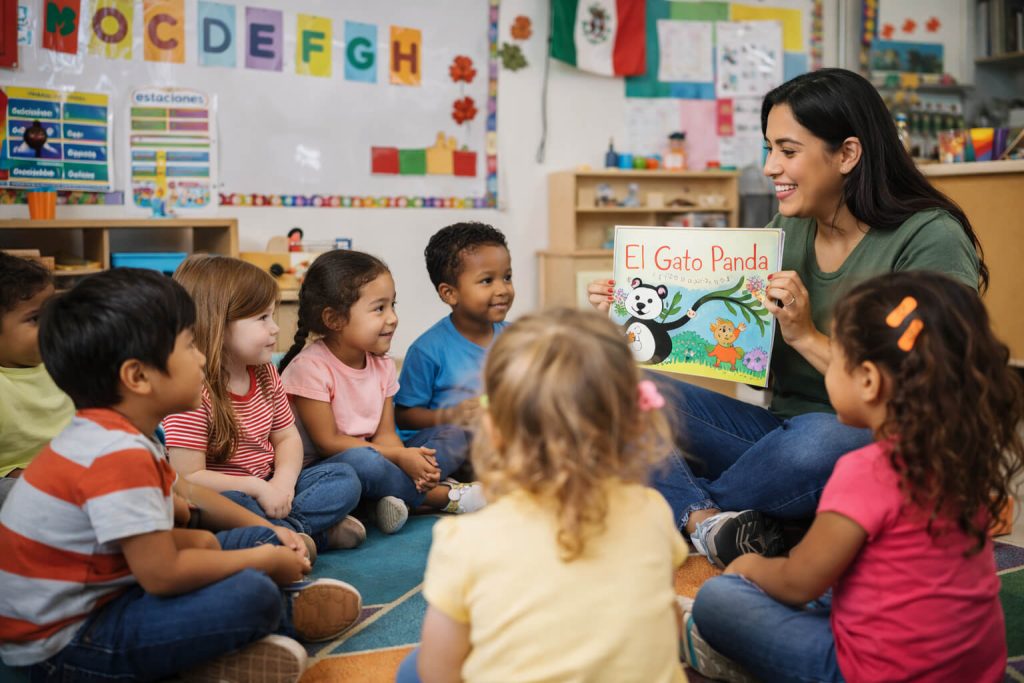
A Spanish immersion preschool is a learning environment where Spanish is the primary language used throughout the day—during play, routines, transitions, and instruction.
Children are not taught Spanish through memorization or formal lessons. Instead, they acquire the language naturally, the same way they learned their first words at home.
Teachers communicate in Spanish during:
- Circle time
- Play-based activities
- Outdoor exploration
- Meals and transitions
- Songs, stories, and hands-on learning
English is not eliminated or discouraged. Children continue developing English naturally at home and through social interaction, while Spanish becomes part of their daily world in a meaningful, supportive way.
There is no pressure to speak perfectly. Understanding comes first, followed by confidence and expression.
Cognitive Benefits Kids Can Actually Feel
The benefits of a Spanish immersion preschool go far beyond learning a second language. Children experience daily mental “workouts” that strengthen core cognitive skills.
Stronger Attention Skills
- Children learn to focus on tone, gestures, and context
- They become better listeners and filter distractions more easily
Improved Memory
- Repeated routines in Spanish strengthen recall
- Songs, stories, and predictable activities build working memory
Better Problem-Solving
- Processing meaning in another language builds mental flexibility
- Children learn to adapt and think creatively
Cognitive Flexibility
- Kids adjust more easily to new routines
- Transitions feel less stressful over time
Greater Confidence
- Understanding and responding in Spanish builds courage
- Children become more comfortable taking healthy social risks
A simple example: A teacher gives directions in Spanish using gestures and visual cues. Children observe, interpret, and act. These small cognitive steps happen dozens of times each day—strengthening the brain in natural, meaningful ways.
Spanish Immersion Preschool vs. Traditional Preschool
Parents often compare a Spanish immersion preschool with a traditional English-based program.
Here’s how they differ:
Language Environment
- Traditional preschool: English with occasional Spanish exposure
- Spanish immersion preschool: Spanish used throughout the day
Learning Structure
- Traditional preschool: Play-based with English instruction
- Spanish immersion preschool: Play-based learning in Spanish
Teacher Communication
- Traditional preschool: English-first instruction
- Spanish immersion preschool: Natural Spanish communication supported by visuals and modeling
Outcomes
- Traditional preschool: Strong English foundation
- Spanish immersion preschool: Cognitive growth + early bilingual foundations
For families seeking deeper cognitive development and cultural exposure, immersion provides consistency that casual language exposure cannot.
What to Look for in a High-Quality Spanish Immersion Program
Not every program that mentions Spanish offers true immersion. Use this checklist when visiting a Spanish immersion preschool:
Program Checklist
- Fluent Spanish-speaking teachers (native or near-native)
- Spanish integrated into daily routines—not just songs
- Visual cues, books, and classroom materials in Spanish
- Play-based learning that keeps language natural
- Small group sizes for individual interaction
- Gentle support for children new to Spanish
- Clear parent communication about progress and adjustment
The most important factor is meaningful daily exposure, delivered in a warm, supportive environment.
Common Parent Questions
Will Spanish immersion cause speech delays?
No. Research shows children in immersion programs develop language skills at the same pace as monolingual peers.
What if my child mixes languages?
That’s completely normal and a healthy sign of language development.
Is immersion hard for shy children?
Many shy children thrive. Teachers use modeling, gestures, and patience to help children participate comfortably.
How can we support English at home?
Talk, read, and engage in English daily. Spanish immersion adds language—it doesn’t replace it.